Most retirees know they have to take their RMDs. Fewer realize the timing is largely up to them, and that choosing wisely can have real tax consequences. Madison Bennett walks through the key timing decisions around required minimum distributions: what drives the choice, how to use your RMD for tax withholding, and when a qualified charitable distribution might make more sense than a standard withdrawal.
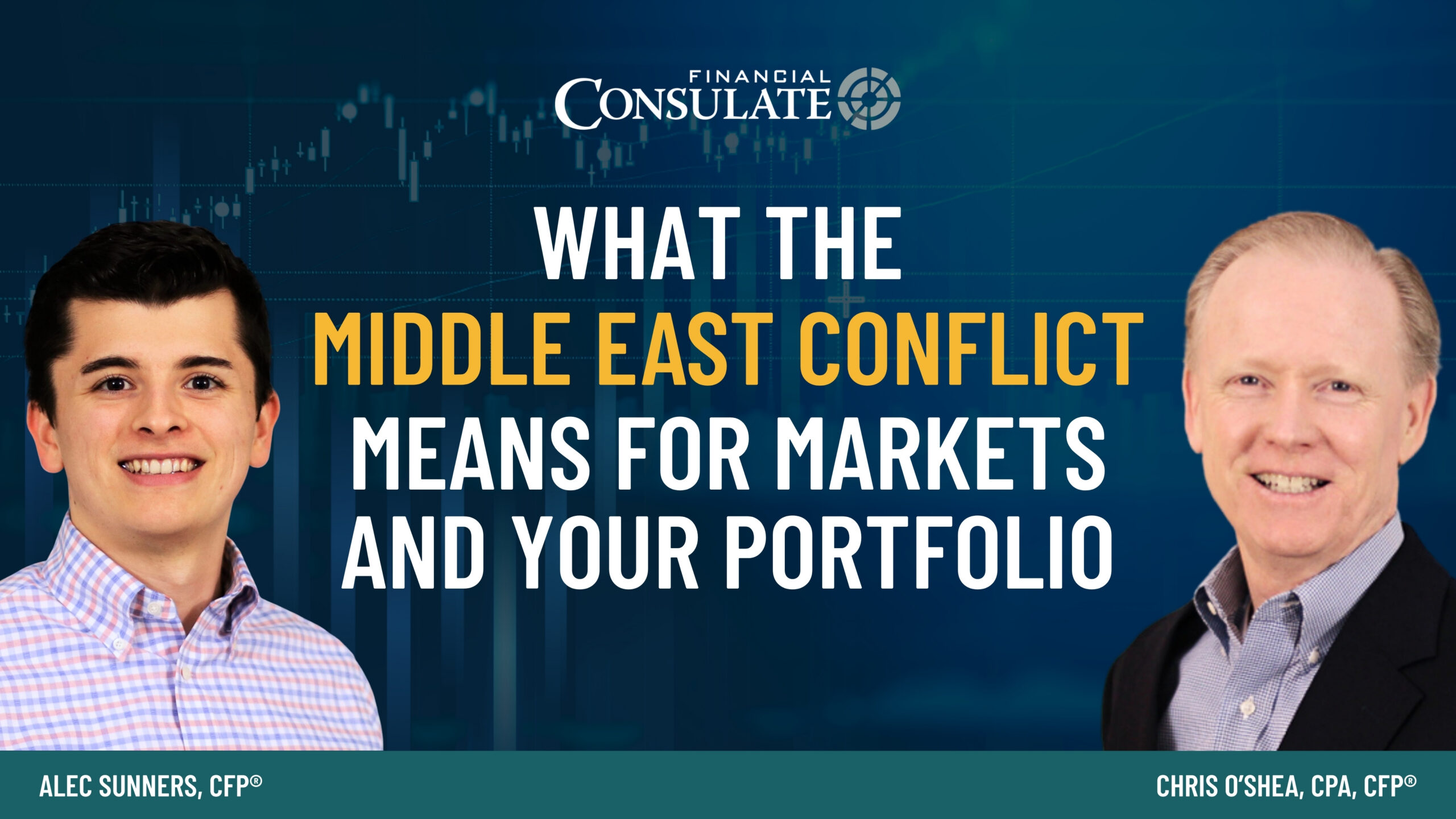
What the Middle East Conflict Means for Markets and Your Portfolio
The ongoing developments in the Middle East have many wondering how such events might affect their investments. In our latest video, Chris O’Shea, our Chief Investment Officer, and Wealth Advisor Alec Sunners discuss what is happening in the markets and what it means for your financial strategy.
They review:
- The market’s typical response to geopolitical events and what is different this time
- The immediate effects of rising oil prices on inflation and interest rates
- The importance of staying focused on long-term investing principles, even when volatility spikes
At Financial Consulate, we believe in helping you stay informed and confident, especially during times of uncertainty. Watch the video now to better understand what’s happening in the markets and how we’re approaching these challenges.
If you have any questions or want to discuss how these changes might affect your financial plan, we’re always here to talk.
Transcript
Alec: We’re recording this on March 13th, 2026. With the recent headlines about the Middle East, we want to take a minute to talk about what’s actually happening with your investments.
Geopolitical Risk vs. Economic Indicators: How Markets React
Alec: So, Chris, as we look at the escalating conflict in Iran and the oil price spike, how do you weigh these events against traditional economic indicators like unemployment or consumer confidence?
Chris: Yeah, thanks, Alec. Good morning. The seriousness of this cannot be understated. I mean, we don’t know what’s going to happen in the end. So, the markets discount news as they get it, but also during these shocks to the geopolitical system, markets have a way of looking through them to see if it’s a regional conflict, is it something less than that? And so, underlying it all are long-term fundamentals.
Oil Price Volatility and Market Reactions in 2026
Chris: So far, markets have been mostly orderly in trading. The only exception to that is oil. Oil had its second largest intraday volatility in history earlier this week. So, like for today, you saw news come out about fourth-quarter GDP, which was cut in half. Some of the growth was cut in half. So, markets are discounting that a little bit. Today, you’re seeing oils down a little bit. You’re seeing bonds are rallying a little bit and stocks are coming back a little bit. So, they discount things.
Are Markets Looking Through the Middle East Conflict?
Chris: But through it all, so far, markets are looking through this conflict as something being limited in nature. But we’ll see; if this were to get bigger, then markets will obviously discount that at the appropriate time. But they’re looking through this, they’re looking for long-term compounding effect. They’ve seen this is what’s happened in the past. And there’s no reason to think that at this point it won’t happen again in the future.
Interest Rates, Inflation, and the Impact of Rising Oil Prices
Alec: Do you think the Middle East conflict makes things more expensive and keeps interest rates high?
Chris: Well, for the short term, they do and they are. Rates are higher. You’re seeing mortgage rates are higher. Oil prices have risen to such a great extent that in the short term, it’s affecting things like gas prices at the pump. And there’s been a hold, interest rates initially went down when the war started, but now they’ve drifted a little higher. So, in the short term, I think, yes, rates are a little higher, but they were in a trading range. It hasn’t broken out above that. Mortgage rates are still lower than they were a year ago.
Strait of Hormuz and Global Oil Supply Risks
Chris: The long term, again, has to do with how this war unfolds and what happens with the supply of oil. You’re seeing that they’re talking about the Strait of Hormuz. Well, they also have this pipeline now in Saudi Arabia that was put in place to really help in these times. The Strait of Hormuz has 20% of the world’s oil supply traveling through there. Unless the worst-case scenario happens in the war, then things should resolve. And I still expect that rates will come down by the end of the year.
Which Stock Market Sectors Are Performing Well in 2026?
Alec: Are there any sectors that are actually doing well?
Chris: Well, as I said, the price of oil is up. So, in the S&P 500, there are 11 sectors that they divided up into. Energy is one. As of last night, energy is the only sector that is up for the year. The rest of the stocks are down. One sector, tech, is flat. So, everyone else is down, the other nine. So, oil is up. That doesn’t impact us. We invest in a diversified way. So, we have exposure to all 11 sectors. So, energy is helping us, but we don’t try to trade around events like this. We really look for the long-term compounding effects of the market, and that’s how we invest. But that is what’s happening so far. So, you will see impacts, obviously, to stocks in your portfolio.
Portfolio Rebalancing Strategy During Market Volatility
Alec: Can you walk us through how our rebalancing process works? How does it help us during times like this?
Chris: Sure, I can. In fact, we rebalanced last quarter because we have some internal triggers that, in the end, stock investing is all about buying low and selling high, right? So, we have mechanisms that help us on either end of the spectrum of the cycle. Markets are going higher. Once it gets to a certain point, we will sell stocks down and put them into the non-stock side of the portfolio that obviously has a lesser rate of return.
And then on the reverse, if markets have dropped to the point where some triggers have hit, that now we’re buying at the low end and positioning for the longer term. In the end, this really levels out some volatility. We think that has done it to an extent this time also. And our rebalancing, as you look at the last 40 years, we probably would have rebalanced under this regime maybe 10 times. So, it isn’t all the time, but it’s when our equity gets either above or below certain levels.
Tax Planning Opportunities: Roth Conversions in a Down Market
Alec: Since we look at everything through a tax lens, does this volatility create any specific opportunities like Roth conversions?
Chris: Well, as you know, we look at the potential for Roth conversions for every client who has IRA accounts every year. And so, we’re always employing a strategy for that. And certainly, markets that have declines, then we surely take advantage of that. Markets haven’t dropped that significantly where it has. Back in 2025, you saw the S&P 500 was down close to 20% in the first quarter of the year. That’s a material drop. And if you’re considering doing a Roth conversion, that’s certainly a good time to execute that strategy.
Investor Advice: How to Handle Market Anxiety
Alec: What is the one piece of advice that you would give to someone who is feeling a little anxious watching the news today?
Chris: That’s a great question, Alec. Related to what I said earlier in the conversation, we’re always looking for the compounding effects of stocks. Our clients know that you could have your money completely safe and get CDs or Treasuries, but you’re getting a lower rate of return. So, for the longer term, assets that you can leave alone and have the benefit of companies’ innovations and strategic thinking, we have some of the best companies in history operating now. And so, as they continue to adjust and adapt to the changes that are going on, risk premiums, meaning that the things that are happening now, markets are adjusting prices along the way, but companies adapt. And the long term has not been clouded to the point where that stocks will continue to do well.
So, we would just say that certainly it’s unnerving overall, and anytime loss of life is involved, it’s just a terrible thing. But for how the markets are discounting, if they still look for the long-term compounding effects of earnings and growth in policy.
Next Steps: Review Your Financial Plan During Market Volatility
Alec: Thanks, Chris. It’s a good reminder that we build these plans to handle exactly this kind of volatility. If you’re feeling uncertain or want to see how your specific plan is holding up, give us a call at 410-823-7283 or visit financialconsulate.com to schedule an intro call. We’re here to help.
Thanks for watching.
Related Posts