We’ve all heard the myth that crossing into a higher tax bracket means every dollar you earn suddenly gets taxed at that higher rate. But that’s not how it works.
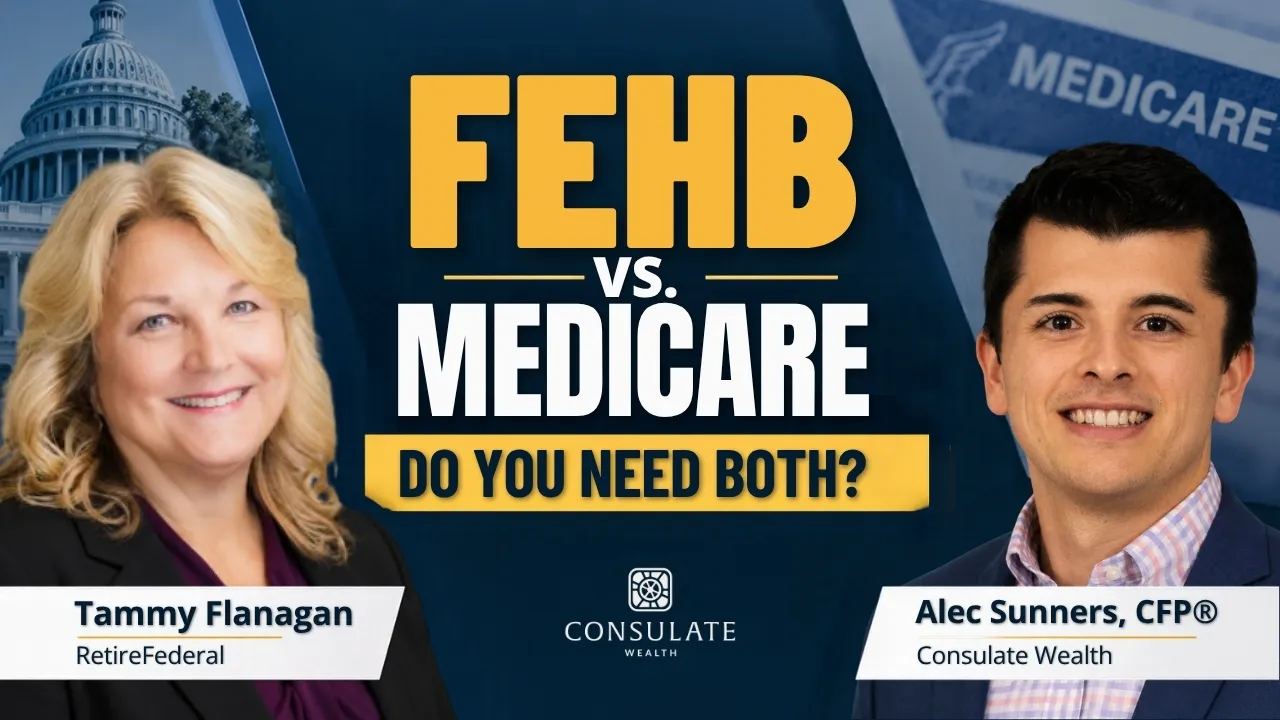
FEHB vs. Medicare: Should You Keep Both?
If you’re a federal employee turning 65, you have decisions to make about your health insurance. You can keep FEHB on its own, or you can add Medicare and use the two together. With both, Medicare pays your medical bills first, and FEHB helps cover what’s left, which may mean smaller bills when you visit the doctor or go to the hospital.
Alec Sunners, Wealth Advisor at Consulate Wealth, sits down with Tammy Flanagan, founder of Retire Federal, who has been helping federal employees plan for retirement since 1985.
Together, they talk through how to decide whether Medicare Part B is worth the monthly premium for you, and why it’s better to decide now.
In this interview:
- How FEHB and Medicare coordinate once you retire
- Whether Medicare Part B is worth the premium if you already have FEHB
- How the Part B late enrollment penalty works
- Suspending vs. canceling FEHB, and where Medicare Advantage fits
- What postal retirees need to know under PSHB
- What to review during Open Season, November 9 through December 14, 2026
Want to see how your health coverage decisions fit with the rest of your retirement and tax plan? Start with a Financial Physical®. Call 410-823-7283 or visit https://financialconsulate.com/contact/.
Frequently Asked Questions
Should federal retirees keep FEHB after enrolling in Medicare?
Eligible federal retirees can keep FEHB after enrolling in Medicare. Whether keeping both makes sense depends on their income, health, travel needs, family coverage, and the specific plans being compared.
Adding Medicare Parts A and B can reduce out-of-pocket costs because Medicare generally pays first in retirement and some FEHB plans waive certain deductibles, co-payments, and coinsurance. Part B adds a monthly premium, although some FEHB plans reimburse part of that cost.
Keeping FEHB with premium-free Part A avoids the additional Part B premium, but FEHB remains the main coverage for doctor visits and outpatient services.
Suspending FEHB for a separate Medicare Advantage plan may reduce premiums, but members still owe the Part B premium. Compare provider access, prescription coverage, cost sharing, and the plan’s out-of-pocket limit, not just monthly premiums. Because canceling retiree FEHB is generally permanent, understand the consequences before making a change.
Do federal retirees have to enroll in Medicare Part B?
Most federal retirees are not required to enroll in Medicare Part B to keep FEHB. Postal retirees have different rules under the Postal Service Health Benefits (PSHB) Program. Certain Medicare-eligible postal annuitants and covered family members must enroll in Part B to keep PSHB coverage, but important exceptions apply. These include qualifying annuitants who retired on or before January 1, 2025, and were not already enrolled in Part B, and employees who were age 64 or older on January 1, 2025, along with their covered family members. Other exceptions may apply, so check your situation with OPM.
What happens if I skip Medicare Part B and want it later?
If you delay Medicare Part B without qualifying for a Special Enrollment Period or another exception, you’ll generally pay a late enrollment penalty when you enroll later. Coverage through your own or a spouse’s current employment may allow you to delay without a penalty; retiree FEHB coverage alone does not. The penalty adds 10% to your Part B premium for each full 12-month period you could have had Part B but didn’t. Retiree FEHB coverage isn’t based on current employment, so it doesn’t qualify you for a Special Enrollment Period. Most retirees who delay sign up during the General Enrollment Period, January 1 through March 31, with coverage starting the month after they enroll. You can read more at Medicare.gov.
Which pays first, FEHB or Medicare?
Once you’re retired and enrolled in Medicare, Medicare generally pays first and FEHB pays second. Many FEHB plans waive some or all of their deductibles and co-pays when Medicare pays first, which can reduce your out-of-pocket costs. If you’re still working for the federal government and covered by FEHB through that job, FEHB generally pays first instead.
What is the difference between suspending and canceling FEHB?
Suspending FEHB pauses your coverage and keeps your right to return, while canceling FEHB ends it permanently. You can suspend FEHB when you enroll in a Medicare Advantage plan, Medicaid, or TRICARE for Life, and you can generally re-enroll during a future Open Season or after certain qualifying life events. If you’re considering a Medicare Advantage plan, suspension gives you a path back if the plan doesn’t suit you.
Transcript
Alec Sunners: If you’re a federal employee or retiree approaching 65, you’ll need to decide what to do with your health insurance. You can generally keep FEHB on its own, or enroll in Medicare and use the two together. If you’re still working and covered through your federal job, FEHB typically pays first.
Once you’re retired, Medicare generally pays first for the services it covers, and FEHB helps cover remaining costs under your plan’s rules. That combination can mean smaller bills when you visit the doctor or go to the hospital. Medicare Part B comes with a monthly premium, so today we’ll talk about how to decide whether it’s worth it for you and why it’s better to decide now.
With federal benefits open season starting November 9th, many federal retirees look at their coverage and wonder whether they’re paying for more than they need, or setting themselves up for a bigger bill later. I’m Alec Sunners, a wealth advisor with Consulate Wealth, and today I’m joined by Tammy Flanagan, founder of Retire Federal. Tammy has been helping federal employees plan for retirement since 1985, and many of you know her from her weekly retirement planning column in Government Executive.
Without further ado, let’s get into it. Thank you so much for joining us, Tammy. I think it’s going to be really helpful to have you here with your expertise to answer all these questions we have for you today.
Tammy Flanagan: Sure, thank you, Alec. I’m happy to be here and happy to share some information with your audience.
Can You Keep FEHB Health Insurance After Federal Retirement?
Alec Sunners: I get this question all the time from new federal employee retirees. What happens to their FEHB when they retire, and does anything change at 65?
Tammy Flanagan: The important thing is that they’re eligible to keep their FEHB in retirement because there are two criteria they have to meet. So as long as they’ve been covered under the overall program, the Federal Employees Health Benefits Program, at retirement and for the last five years of their career, that’s one of the conditions.
And then the other condition is they have to be eligible for an immediate retirement because sometimes people leave federal service, but they’re not eligible to retire, but they can collect the deferred retirement maybe five or ten years down the road. But to keep your health insurance, it has to be a retirement that I’m going to start collecting next month. So those are the two conditions.
And then once you carry that benefit into retirement, you have it for the rest of your life. So that part doesn’t change when you turn 65. You can still maintain that federal health insurance.
And in most cases, retirees use that to supplement Medicare once they turn 65 or once they decide to enroll.
How Do FEHB Premiums and Taxes Change in Retirement?
Alec Sunners: And then I know a lot of people just pay for their FEHB out of their paycheck. They don’t think about it. How does that change in retirement? How do retirees pay for it once they leave the federal service?
Tammy Flanagan: Good question. So as employees, you’re paid biweekly, generally in federal service.
So retirees get a check or a direct deposit once a month for their annuity check from either civil service, the old retirement system, or the Federal Employee’s Retirement System. So this is all happening at the Office of Personnel Management. So there’s actually a transition from the agency they were employed with.
Now everything is transferred over to the Office of Personnel Management where they get paid their retirement benefit. They call it their basic retirement benefit. So out of that check comes their premiums for health insurance on a monthly basis.
So it kind of looks like they’re paying for it more than they were as an employee, but it’s still the same premium just divided up over 12 months. The part that is more expensive for retirees is the fact that they don’t get to pay those premiums with pre-tax money. So the withholding for the health insurance is going to come out after-tax, which is the opposite of what happened while they were employed.
For whatever reason, Congress never got around to including that tax break for retirees like they did for employees around way back in 2001, that legislation passed. They called it premium conversion, but that’s strictly an employee benefit. Right.
Which Pays First After Retirement: FEHB or Medicare?
Alec Sunners: And then if someone chooses to keep their FEHB and enrolls in Medicare, which one of them pays first for health care?
Tammy Flanagan: Once they’re retired, Medicare would by law become the primary payer. Now, if they’re still working or possibly their spouse is still working and they’re having health insurance deducted from a paycheck, they can delay Medicare enrollment without a late enrollment penalty. So if a federal employee is still working when they turn 65, they can enroll in Part A because there’s no premium for Part A since we’ve already paid that payroll tax.
That’s going to help out only if they get admitted to an inpatient facility like a hospital or rehab or things like that. But Part B, generally employees don’t enroll in that part of Medicare until after they retire and of course have to be 65. If you’re 55, you don’t have to worry about it yet.
So at 65, they have to make a decision. Do I take Part B or do I just continue on with my health insurance by itself? So what they don’t always understand is what is that relationship? How do those two benefits coordinate? That’s what’s important to teach.
What Does FEHB Cover That Medicare Does Not?
Alec Sunners: And are there things that FEHB would cover that Medicare doesn’t cover?
Tammy Flanagan: There are some things that not all federal employees or federal health plans include these, but things like some basic dental coverage or vision checkups, you know, some plans will have those benefits built into the insurance or federal employees can buy supplemental dental or vision coverage because Medicare doesn’t cover routine exams for your eyes or dental checkups.
So that would be one thing. Some other things that might be covered through your federal plan that Medicare doesn’t cover, maybe some perks, such as, if some of the plans cover massage therapy, believe it or not, and Medicare doesn’t cover that. So you have to look at each individual plan because we have over 100 and some different federal health plans.
So each one has its own little set of benefits that are included as part of that premium. Some of them could be additional benefits that you can buy into or discounted benefits. Right.
So, yeah, there’s that. But there’s also things that Medicare covers that your federal health plan either doesn’t cover or has limitations on. And that’s really the important thing that they need to understand.
So, for instance, let’s say somebody has a stroke and they’re in their 80s. So the recovery from that stroke may not ever happen completely. So during that time of recovery, they’re getting extensive physical therapy.
Well, most federal health plans might only cover 30 or maybe 50 visits to a physical therapist where Medicare says, as long as your doctor says you need that physical therapy, it can happen every week for the next three years. So Medicare has less restrictions on the number of services that you get if it’s medically necessary. Original Medicare, which is A and B, generally will cover that without any referrals or preauthorizations or anything like that. Original Medicare is very flexible and very liberal, believe it or not.
Medicare Part A and Health Savings Account Rules for Federal Employees
Alec Sunners: And you had mentioned that Medicare Part A is free. Is there ever a reason for someone not to take it if they’re a federal employee, retiree?
Tammy Flanagan: Sometimes. And these are becoming more popular. High deductible health plans that have a health savings account attached to it.
So if you’re still working and you have a high deductible plan and you’re stocking away some nice amounts of tax-free dollars into that HSA account, you won’t be able to do that if you enroll in any part of Medicare. So sometimes when employees are still working past age 65, if they’re using that type of insurance with an HSA or health savings account, they will delay Part A enrollment until either they retire or until the time that they decide to enroll in Social Security retirement. Because when you pick up Social Security retirement, you’re automatically enrolled in Part A of Medicare.
Is Medicare Part B Worth It If You Already Have FEHB?
Alec Sunners: So Part A seems more black and white, depending on your circumstances. But Part B is where I think a lot of people disagree on whether it’s worth it to sign up for Part B as well. What does that premium for Part B get you if you already have FEHB?
Tammy Flanagan: So many, not every plan, but every carrier. So there’s Blue Cross, there’s Aetna, there’s all these different health plan carriers within the Federal Health Benefits Program.
So let’s take Blue Cross, for instance. Blue Cross has three different plans for federal employees. One is called Focus, one is called Standard Option, and one is called Basic.
Well, they funnel all of the retirees to the Basic option because that provides the most perks. It has a lower premium than Standard Option. It waives your deductible and co-pays and co-insurance, so you have no out-of-pocket expense.
When Medicare pays first, Blue Cross Basic will pick up the rest. The only thing that Blue Cross Basic requires is that you use Blue Cross Preferred Providers. But that’s the only condition.
Plus, they also give you a rebate of $800 a year. And if it’s two people, a married couple, they would get $1,600 a year towards the cost of Part B. So they get a rebate of part of that premium. So that’s true in every federal family, whether it’s Aetna, where Aetna Direct and Aetna Advantage are the two plans that kind of cater to retirees with Medicare.
So it’s important for federal employees and especially retirees to be open to the idea that the plan that they’ve had for the last 45 years may not be the best plan moving forward, because they can probably save some money by choosing a plan that really dovetails nicely with Medicare. And like I said, every family of plans has one that’s going to do that.
What Happens If Federal Retirees Delay Medicare Part B?
Alec Sunners: And what happens if someone turns 65 and they decide, I don’t think Medicare Part B is worth it. I’m not going to sign up for it. I’m going to keep my current benefits. And then later in life, they say, actually, I do think I want Medicare Part B. What happens?
Tammy Flanagan: Yes, that happens quite a bit because there’s about one out of four federal retirees who choose not to take Part B. They’ll probably sign up for Part A, no problem.
But that Part B has a premium, which this year it’s $202.40 a month. Next year, I think it’s going up to $209. That hasn’t been announced yet, but should be around $209 a month. So they don’t want to pay that, obviously, because they’re already paying for health insurance. So they delay their decision. And they find out later in life, you know, they’ve been healthy for 68 years, but now I’ve come down with a chronic illness. And that has multiplied into two chronic illnesses. And now it’s like, man, I’m scheduling my social life around my doctor visits. I better look into that Medicare again.
Unfortunately, what they find out is that for every 12 months, since the end of their initial enrollment period, for every 12 months that’s gone by, they’re going to pay 10% more than that premium. And if they’re higher income retirees, they’re going to pay even more because there’s a law that says retirees who have high income have to pick up more of the cost of Part B. That $202 a month is only paying about 25% of the cost of Part B. So retirees with higher income pay more and retirees who delay their decision pay more.
And so it’s really not cost effective to wait 10 years. Sometimes it’s okay, if you’re going to wait a year or two, maybe your income is going to come down because you’re working a second career. And that’s not going to be too devastating. But if you wait 10 or 15 years, you better forever hold your peace with your decision.
How Roth Conversions Can Affect Medicare IRMAA Premiums
Alec Sunners: We often work with our clients on Roth conversions in a year from either the TSP or an IRA, and that can cause higher Part B premiums. Yes. How often do you see that catch federal retirees off guard? All the time?
Tammy Flanagan: Yes. It happens a lot because they don’t realize that because they did that, that’s going to bump up their premium, not this year, but next year. So right now, you know, Social Security is getting ready to come out with the premiums for 2027. So retirees will get a letter in the mail telling them how much their Part B premium is going to be next year.
But that rate is based on their tax return from 2025, the one they just filed this past April. So they already did the deed. If they converted a Roth conversion too late, you can’t change that.
So for a year or two, you might have to pay that higher premium, but then it’ll come back down because once they get your tax return for 2027, and they say, Oh, you didn’t do that this year.
So now your premium will automatically go down. Now, if you have a life changing event, like let’s say you go through a divorce, or your spouse passes away, or maybe you just retired, and they’re looking at 2025, when you were working, those are times you can appeal that IRMAA surcharge, that high income surcharge, you can just go ahead and tell Social Security right away, look, you know, that’s what I was making in 2025.
But because my spouse died, my income got cut in half. So, now here’s what I’m making. So I don’t need to pay that IRMAA.
There’s an appeal, I think it’s a standard form or a Social Security form. I can’t remember the name of it. But you can go on Social Security’s website and find that appeal form.
Alec Sunners: I think it’s called the SSA-44.
Working Past Age 65: When Can You Delay Medicare Part B?
Alec Sunners: I think there’s a lot of misconceptions with Medicare. And a lot of people assume that if they hit age 65, they have to sign up for Medicare Part B. Otherwise, they’ll be hit with that penalty you talked about. But what happens if someone is still working past age 65? Do they still have to sign up right away?
Tammy Flanagan: There’s what’s called a special enrollment period. So if you’re working and you have health insurance through your employer, that’s the key, not just working, because a lot of retirees work, but their health insurance is coming out of their retirement check. So if you’re still working in the government, you have health insurance coming out of your paycheck, or maybe out of your spouse’s paycheck, because they’re still working, you’re going to have a special enrollment period when that working spouse retires.
And from the date of retirement, from the month after they retire, there’s an eight-month window to sign up for Part B with no late enrollment penalty. I’ve had clients that retire at age 78, and they just then pick up Part B, and they’re paying just the going rate because they’ve been working and had their health insurance coming out of their paycheck until then. So to me, that’s wonderful savings.
They haven’t had to pay that premium for all those years, and now that they’re retiring and they’re closer to that age where some things can go wrong with your health, it’s not going to get better when we get older. We have things that come up that we want to maintain our health, or improve our health, or recover from something. So Medicare becomes much more important in those later years.
Suspending vs. Canceling FEHB Coverage in Retirement
Alec Sunners: And speaking of those later years, federal retirees have an option to suspend or cancel their FEHB. What is the difference between the two of them?
Tammy Flanagan: Big difference. So I almost never say never, but in this case I’m going to say never tell an employee to cancel their FEHB coverage. Because even throughout retirement, the government is still picking up close to three-fourths of the premium. So if you looked at the actual premium for your federal health insurance, it’s a lot more than what’s coming out of your retirement check or your paycheck. So I would never consider canceling that.
But for some retirees, they have a reason to suspend that federal health coverage. Because if you’re a retiree who’s eligible for military health care, like TRICARE, when you turn 65 and you’re retired from military service, TRICARE for Life requires that you enroll in Medicare A and B, but there’s no premium for TRICARE for Life. You’ve already paid for that with your military service.
So I would tell that retiree, why don’t you try suspending your federal plan, use the TRICARE for Life with Medicare A and B, and all you’re going to pay for is Medicare Part B. TRICARE for Life includes prescription drug coverage, it covers all the costs that Medicare doesn’t cover, so it’s a good wraparound coverage, and I think you’ll be happy with it. So that’s one common situation where a retiree might suspend their federal health insurance to use that benefit that they’ve earned through their military service or maybe through their spouse’s military service.
The other reasons to suspend FEHB, and these are less frequent, one would be if you join the Peace Corps and you go off for two years of volunteer service, they’ll put you under their health plan so you can suspend the federal plan so you don’t have to pay for both.
Also, if you’re going to join an individual Medicare Advantage plan, you can suspend FEHB and do that, but you’re going to find that those individual Medicare Advantage plans that you’ll find when you go to Medicare.gov are different from the Medicare Advantage options that are available through your FEHB carrier. Those are going to be much more liberal and nationwide coverage in many cases. They don’t penalize you if you drop the Advantage option and go right back to your federal health plan.
So I normally tell a retiree who’s thinking about suspending FEHB to join one of those free Medicare Advantage plans that are advertised on television to try out the one through their federal health plan first because most of the plans will offer a Medicare Advantage option through that FEHB carrier. Even though you’re still going to have to pay the premium, you get a lot more for your money and less restrictions. So that would be another.
And then the final reason you can suspend your federal plan is if you’re very low income and you’re on assistance for Medicare premiums, you’re getting extra help, then those employees or those retirees, I should say, can suspend their federal plan because they may be getting Medicaid and Medicare benefits. But that’s, again, not too many of our retirees.
Medicare Advantage for Federal Retirees: Benefits and Drawbacks
Alec Sunners: And you mentioned Medicare Advantage. I think this is a good topic to cover because you see ads on TV all the time. You get letters in the mail about Medicare Advantage. Who seems to do well with a Medicare Advantage plan and who do you think doesn’t do well with a Medicare Advantage plan?
Tammy Flanagan: I’m a little fearful of joining an Advantage plan myself, so I’ve always stuck with a traditional health plan supplementing Medicare A and B. And my fear is in the fact that some of the Advantage plans have a reputation of having more denials of services or need for preapproval. So you’d have to appeal something that the plan doesn’t want to pay for because who’s in charge of deciding whether or not I get that test or get that surgery or whatever it is, is the health plan, not Medicare. And as I mentioned before, Medicare is more liberal.
They want doctors and providers to participate, so they pretty much okay most things that they ask for. But with the Advantage plans, the plan itself, the company, whether it’s Aetna or Cigna or UnitedHealthcare, they get the money from Medicare first, up front, based on how many people are enrolled in that plan, based on their illnesses. And then during the plan year, when your provider submits claims, they decide whether or not you need that service.
So I’m just a little more fearful that that would happen. And I have talked to retirees who have gone through that. With the ones through the federal plans, they’ve usually overturned the appeal.
Their doctor made contact and said, no, they need this, and then they get it done anyway. But it’s just that whole frustration of having to go through an appeal process with a service that you need today, and now you have to wait a couple of weeks till the appeal is overturned. But what they do offer and what they’re popular for is if you join one of the Advantage plans through the federal health program, you’re going to get a reduction in your Part B premium.
I had said before that some plans will give you a rebate. That’s like you apply for a check and they send you $800 or $900 in the mail. But with an Advantage plan, your actual premium that comes out of your Social Security check or that you’re paying directly is going to go down by $75, $100, $125, depending on which plan you’re in.
So you have an immediate savings off of Medicare. And then they also give you perks. I call them perks because they’re things that aren’t really healthcare related so much as just nice things to have, such as free gym membership or meal delivery after you come out of the hospital or non-emergency transportation to doctor visits.
If you live alone and you need someone to drive you to the doctors, you don’t have to ask your neighbor. They’ll send an Uber through your health plan. So there’s those things that are very attractive, especially to older retirees who might not be so worried about the restricted networks or the fact that they have to choose doctors that are part of that plan or that will bill that plan.
So I would tell a retiree if they want to step into that Medicare Part C or Medicare Advantage venue to do it through one of their federal health plan carriers. I think they’ll be happier with the coverage, even though they still have to pay the premium and they still have to have Part B too. So it doesn’t get you out of Part B if you join an Advantage plan.
FEHB Open Season: What to Review for 2027 Coverage
Alec Sunners: Open season runs November 9th through December 14th. What should federal retirees review before that closes?
Tammy Flanagan: I’ve already been getting emails even before open season starts because many of the plans will have their open season brochures available. Most of them, I think all of them have them now. So I say, look at your plan for next year. What’s changing? The premium might be going up.
In some cases it’s going down. Some of the premiums are going up triple digits, like the Mail Handlers Benefit Plan is going up over $100 a month. So if you’re in that plan, you might want to look around or make sure you’re aware of that cost because maybe you want to switch to a different plan.
So look at what you currently have and see what’s changing. Is it the deductible, the catastrophic limit on how much you’re going to have to spend or the premium? Or it could be coverage for your prescriptions. Most of the plans now are making you pay 50 percent of your GLP-1.
Those are those weight loss medications that so many people are taking. And it also, of course, treats diabetes. But next year, you might find that your plan, which only had a small co-pay this year, is going to make you pay 50 percent of that cost next year, which could be quite a bit of an increase to what you’re spending out of pocket.
So look at what you have. Look at how it’s changing. And then look at the other plans that are out there that provide the same types of benefits.
If you like a nationwide plan, you’re not interested in an HMO, just look at those and then look at the standard option versus the high option, because the standard options, you’re going to have to pay more out of pocket where the high options might have a higher premium, but lesser co-pays and lesser deductibles. And both of those may dovetail with Medicare. So just make sure that that’s the case if you’re over 65.
So that’s the part that people don’t want to do because it is tedious. We do a lot of work with individual clients to help them sort through all the options and figure out which three or four plans might work best. And then we narrow it down to which one looks like it’s going to fit the best for them.
So that’s something that you really have to spend some time on. There’s no way to get around that.
Postal Service Health Benefits (PSHB) and Medicare Enrollment Rules
Alec Sunners: And specifically, I’ve gotten this question a couple of times now, postal retirees are now part of the PSHB program. What should they be double checking?
Tammy Flanagan: Yeah, postal retirees just recently, this was only since January of 2025, were put into a subset of the FEHB program, as you said, called the Postal Service Health Benefits Program. What’s different about that is if they’re over 65, in many cases, they are required to enroll in Part B of Medicare. They are required to have Part D of Medicare, which is the prescription drug benefit.
If they drop either one of those, they’re going to lose their health insurance or their prescription drug coverage. So be sure that you’re aware of those requirements if you’re a postal retiree. There were some exceptions, you know, for people who were already 65 by January 1st of 2025, or for retirees who didn’t already have Part B, they were given the leeway to not have to take it.
But if you’re a postal retiree, check opm.gov or your union, the American Postal Workers Union or the National Association of Letter Carriers, and they have a lot of information about those new requirements.
Common FEHB and Medicare Mistakes Federal Retirees Make
Alec Sunners: So to close us out, Tammy, what is the most common mistake you see with federal retirees and how to make the decision between FEHB and Medicare?
Tammy Flanagan: I see a lot of folks who just stay with the same federal health plan that they’ve had all their career and just tack on Medicare. And so now they’re paying a lot more than they really need to be paying.
Because unlike what my mother told me, you get what you pay for. Sometimes the best health plan is not the most expensive one, especially when you’re tying it together with Medicare. There’s Aetna Direct, there’s Blue Cross Basic, there’s GEHA Standard Option, those three plans have relatively lower premiums, and they go really nicely together with Medicare.
And they don’t cost as much as Blue Cross Standard or GEHA High Option. So look at those plans that really have the incentives to get you to enroll in Medicare. And you might find that those are the plans with the lowest premiums, but really the best wraparound coverage.
Alec Sunners: That’s great, Tammy. Thank you so much. I think this has been so helpful.
Tammy Flanagan: You’re welcome, Alec. Thank you for inviting me.
How to Decide Between FEHB and Medicare in Retirement
Alec Sunners: If you’re watching and trying to make this decision, there isn’t one right answer for every federal retiree. The right mix of FEHB and Medicare depends on your income, your health, how much you travel, and what your plan costs you today. Try not to make the Part B decision by default and find out years later that it costs you more than it saved.
If you’d like to see how these decisions fit into the rest of your retirement plan, you can learn more at ConsulateWealth.com. And to keep learning from Tammy, visit RetireFederal.com. Thanks for watching. See you next time.
Related Posts